
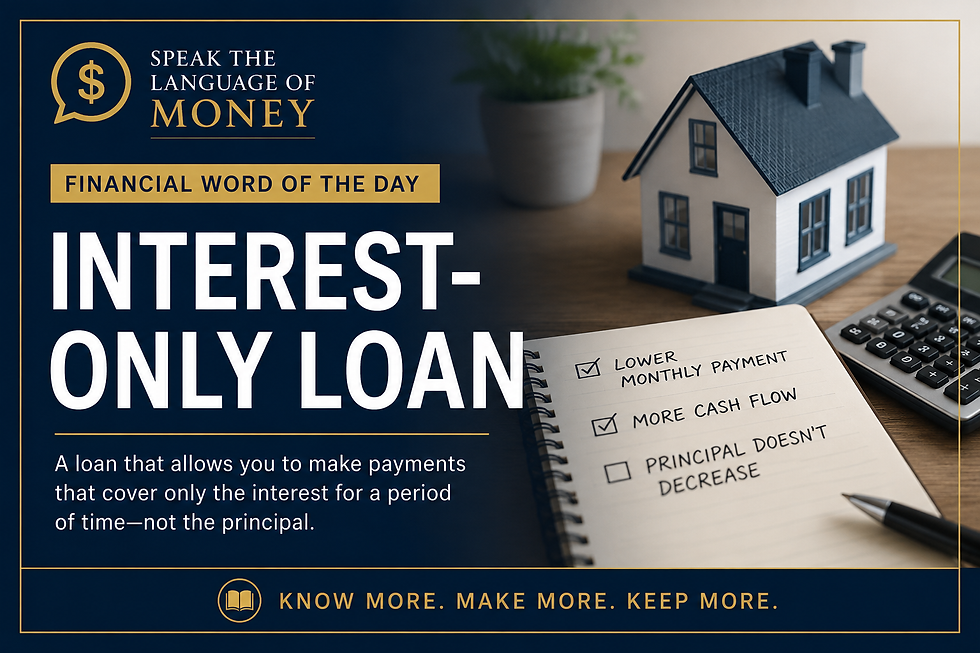
Financial Word of the Day: Interest-Only Loan

Debt can be a useful financial tool—but sometimes the smallest monthly payment isn’t actually the cheapest option.
That’s especially true with an interest-only loan.
What Is an Interest-Only Loan?
An interest-only loan is a loan that allows you, for a certain period of time, to make payments that cover only the interest being charged on the debt rather than paying down the principal balance.
In other words, you’re paying the lender for the privilege of borrowing the money, but you’re not necessarily reducing how much you owe.
Suppose you borrow $200,000 at 6% interest and the loan allows interest-only payments.
Your annual interest would be approximately: $200,000 × 6% = $12,000
Divide that by 12 months, and your interest-only payment would be approximately: $1,000 per month
After making $1,000 payments for an entire year, however, you could still owe the original $200,000.
That’s the important part.
Why Would Someone Use an Interest-Only Loan?
The obvious advantage is cash flow.
Because you aren’t required to pay principal during the interest-only period, your monthly payment can be considerably lower than it would be with a traditional amortizing loan.
Real estate investors sometimes use interest-only financing when purchasing investment properties. A business owner might use it to keep more cash available for operations. Someone buying or renovating a property might use an interest-only period while waiting for the property to begin producing income.
Used strategically, the lower payment can provide financial flexibility. But flexibility and affordability aren’t the same thing.

The Danger of Interest-Only Loans
The biggest risk is simple: Your debt may not be shrinking.
With a traditional loan, each payment generally includes both interest and principal. Over time, your loan balance gradually declines.
With an interest-only loan, you can make payments month after month and still owe essentially the same amount.
There’s another potential surprise.
The interest-only period usually doesn’t last forever. When it ends, the loan may begin requiring principal payments, resulting in a significantly higher monthly payment. Depending on the loan terms, you could also face a balloon payment or need to refinance.
That means you need an exit strategy before entering the loan, not after.
How to Use the Term "Interest-Only Loan" in Conversation
You might say: “The property produces good cash flow with an interest-only loan, but I want to know what the payment becomes when the interest-only period ends.”
That one question makes you sound financially savvy because you’re looking beyond today’s payment.
Why an Interest-Only Loan Matters to Your Money
Interest-only loans aren’t automatically good or bad.
They’re tools.
For an investor or business owner with strong cash flow, adequate reserves, and a clear repayment strategy, an interest-only loan can preserve capital for other opportunities.
For someone simply using the loan to afford something that would otherwise be beyond their budget, it can become dangerous.
Remember this: A lower payment doesn’t necessarily mean a lower cost.
When evaluating any loan, don’t just ask: “What’s my monthly payment?”
Also ask: “How much principal am I actually paying down?”
That question can change the way you think about debt, and help you speak the language of money.


Comments