
Financial Word of the Day: Tick Chart
- Larry Jones

- Oct 29, 2025
- 2 min read
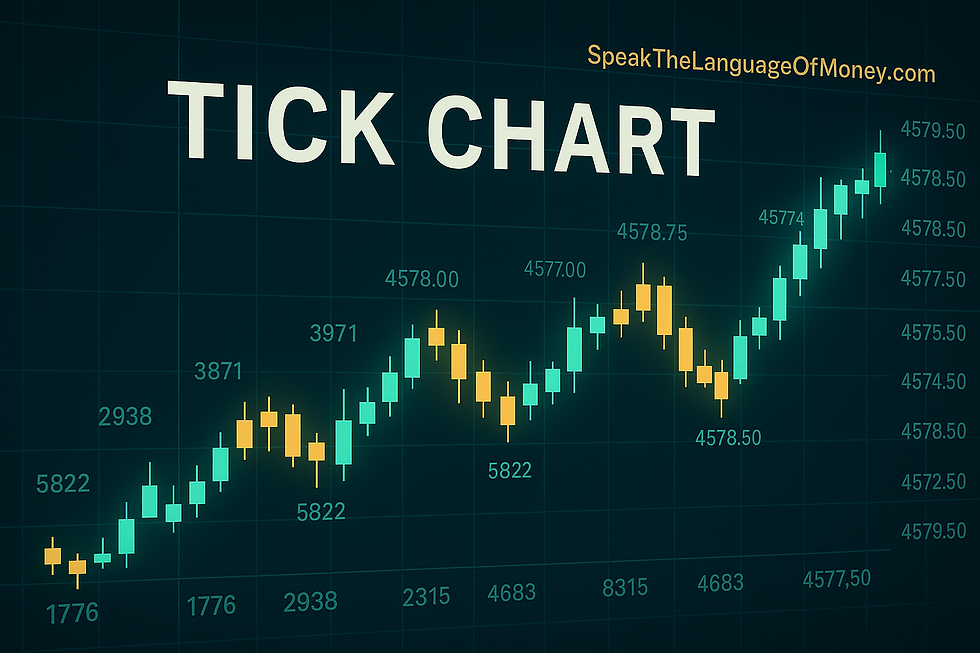
Definition of a Tick Chart
A tick chart is a type of financial chart that plots price movement based on a specific number of transactions — or “ticks” — rather than time. Unlike traditional charts that show how a stock or asset performs over minutes, hours, or days, a tick chart updates only when a set number of trades have occurred.
For example, on a 100-tick chart, every bar or candlestick represents the price action of 100 trades, regardless of how long it takes for those trades to happen. If trading is heavy, the chart updates quickly. If trading slows, it updates slowly.
Why a Tick Chart Matters
Tick charts help traders see market activity in real time and filter out the “dead zones” that time-based charts often include. This makes them a favorite among day traders and active investors who want a sharper look at short-term momentum, volatility, and trade flow.
They reveal the rhythm of the market — not based on the clock, but on actual trading energy.
For instance, in the first 15 minutes after the stock market opens, thousands of trades may happen within seconds. A 200-tick chart could form multiple bars during that time, showing detailed price swings that a one-minute or five-minute chart would completely miss.
On the flip side, during slow mid-day trading, it might take several minutes before another bar appears — giving a truer reflection of when the market is actually moving.

In Conversation
“I switched to a 500-tick chart this morning and could finally see where the real buying pressure was happening.”
“Tick charts help me avoid the noise that comes with time-based candles during slow trading sessions.”
Real-World Application
Let’s say you’re trading the S&P 500 futures contract. On a busy morning, a 233-tick chart might generate dozens of candles in just five minutes. This allows you to spot fast-moving reversals or breakouts. But as the day slows, fewer trades mean fewer candles — keeping your attention only on the meaningful movement.
That’s why many professional traders combine tick charts with volume or order flow data. It’s like switching from a wide-angle camera to a zoom lens — you’re not seeing more time, you’re seeing more detail.
The Takeaway
A tick chart doesn’t care what time it is — it only cares when something actually happens.It’s a way to visualize trading activity with precision and timing that time-based charts can’t offer.
If you ever feel like traditional charts show “too much empty space,” tick charts can give you a clearer pulse of the market’s heartbeat.
Quick Tip
You don’t need to be a day trader to appreciate tick charts. Even casual investors can use them to study how market momentum behaves at open and close — those key moments when professional money moves first.


Comments