
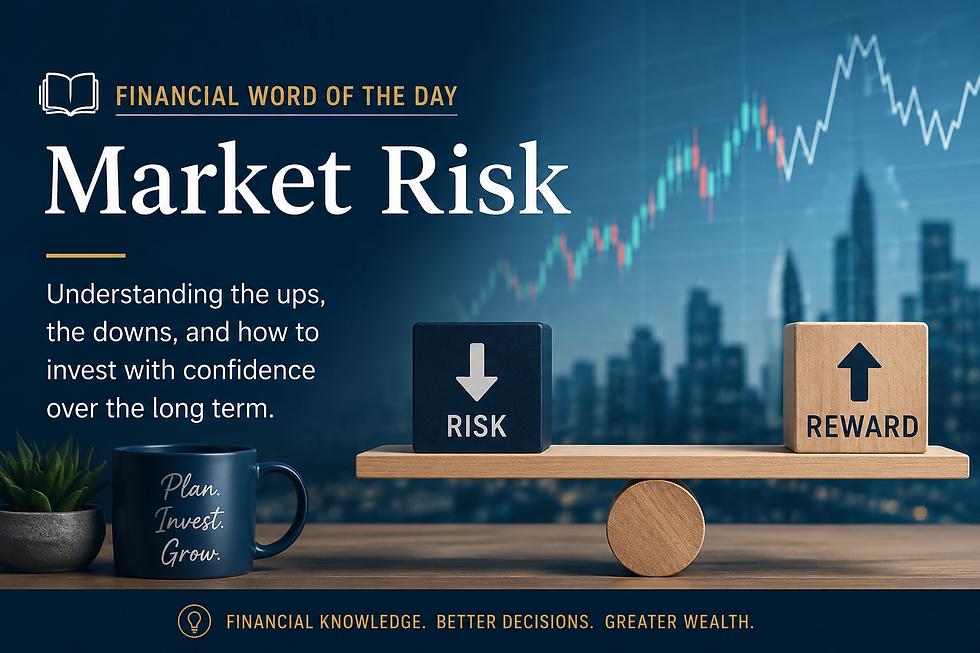
Financial Word of the Day: Market Risk

What Is Market Risk?
Have you ever checked your investment account and noticed it was worth less than it was yesterday, even though you didn't buy or sell anything?
That's market risk in action.
Market risk is the possibility that the value of an investment will decrease because of factors that affect the overall financial markets. These factors can include economic conditions, interest rates, inflation, geopolitical events, government policies, or investor sentiment. Unlike the risk of a single company performing poorly, market risk impacts many investments at the same time.
In simple terms, market risk is the price investors pay for having the opportunity to earn higher long-term returns.
A Simple Example of Market Risk
Imagine you invest $10,000 in a diversified stock market index fund.
A month later, the economy enters a period of uncertainty. Investors become nervous, stock prices fall across the market, and your investment is now worth $9,200.
Did the companies suddenly become worthless? Probably not.
The market simply reacted to changing economic conditions. That's market risk. The value of your investment fluctuated because the entire market moved, not because you made a poor investment choice.
How You Might Hear "Market Risk" Used
Someone might say: "I expect some market risk in my portfolio, but I'm investing for the next 25 years, so I'm not worried about short-term swings."
Or: "As I get closer to retirement, I'm reducing my market risk by shifting some of my investments into bonds and cash."
Both statements recognize that market risk is normal and can be managed, even though it can't be completely eliminated.
Can Market Risk Be Avoided?
Not entirely.
If you invest in stocks, mutual funds, ETFs, or many types of real estate, you'll experience some level of market risk.
However, you can reduce its impact by:
Diversifying across many investments.
Investing for the long term instead of trying to predict daily market movements.
Maintaining an emergency fund so you're not forced to sell investments during a downturn.
Adjusting your investment mix based on your age, goals, and comfort with volatility.
One of the biggest mistakes investors make is confusing temporary market declines with permanent financial loss. Market downturns are uncomfortable, but history has shown that disciplined investors who stay invested have often been rewarded over time.
Why The Word "Market Risk" Matters
Understanding market risk changes the way you think about investing.
Instead of fearing every market decline, you begin to recognize that fluctuations are a normal part of building long-term wealth. Every investment that offers meaningful growth potential comes with some level of uncertainty.
The goal isn't to eliminate market risk. The goal is to understand it, prepare for it, and avoid making emotional decisions when markets inevitably move up and down.
Wise investors don't panic when markets fall. They build a plan that assumes market risk will happen and stay committed to their long-term strategy.
Today's Takeaway: Market risk is unavoidable, but it doesn't have to be feared. When you understand that temporary market swings are a normal part of investing, you're far more likely to stay the course and give your money the opportunity to grow over time.


Comments