
Financial Word of the Day: Reinvestment Risk

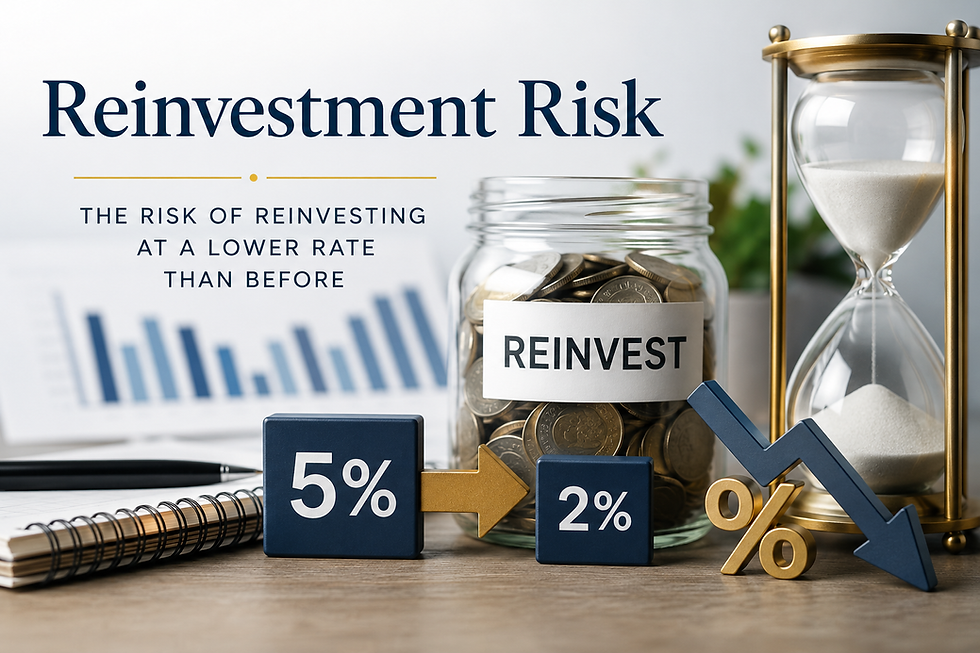
When most people think about investment risk, they think about losing money because the market goes down. But there's another risk that can quietly reduce your long-term returns even when your investment performs exactly as expected. It's called reinvestment risk.
Understanding this concept can help you make smarter decisions about bonds, certificates of deposit (CDs), dividend-paying stocks, and other income-producing investments.
What Is Reinvestment Risk?
Reinvestment risk is the possibility that you'll have to reinvest money from an investment at a lower interest rate or rate of return than you were previously earning.
In simple terms, your investment pays you interest, dividends, or principal, but when it's time to put that money back to work, attractive investment opportunities may no longer exist.
The result? Your future earnings may be lower than you originally expected.
A Simple Example of Reinvestment Risk
Imagine you invest $100,000 in a five-year certificate of deposit earning 5% interest.
Five years later, your CD matures, and you're ready to invest the money again. Unfortunately, interest rates have fallen, and similar CDs now pay only 2%.
Even though your original investment performed exactly as promised, your future income has dropped significantly simply because you had to reinvest at a lower rate.
That's reinvestment risk.
Where Reinvestment Risk Shows Up
Reinvestment risk is most common with investments that make periodic payments, including:
Bonds
Bond funds
Certificates of Deposit (CDs)
Treasury securities
Dividend-paying stocks
Preferred stocks
Every time you receive interest, dividends, or principal repayments, you face the decision of where to invest that money next.
Why Reinvestment Risk Matters
Many investors build retirement plans around predictable income.
But if interest rates decline over time, those future income projections may no longer be realistic.
For example, someone planning to live on interest from a bond ladder may discover that replacing maturing bonds becomes increasingly difficult during periods of low interest rates.
Over many years, reinvestment risk can quietly reduce both income and long-term portfolio growth.
How Investors Can Reduce Reinvestment Risk
While you can't eliminate reinvestment risk entirely, you can manage it.
Some common strategies include:
Building a bond ladder with different maturity dates.
Diversifying across multiple types of investments.
Choosing investments with longer maturities when appropriate.
Reinvesting gradually instead of all at once.
Maintaining a diversified portfolio that includes assets with growth potential in addition to income-producing investments.
No strategy is perfect, but diversification helps reduce dependence on any single interest-rate environment.
Using the Term Reinvestment Risk in Everyday Conversation
Here's an example: "I'm thinking about buying a short-term bond, but I'm also considering the reinvestment risk if interest rates fall before it matures."
Or: "The bond paid exactly what it promised. The challenge came when I had to reinvest the proceeds at a much lower rate."
Final Thought
Reinvestment risk reminds us that investing isn't only about today's return. It's also about what happens after today's investment ends.
Interest rates rise and fall over time, and those changes can have a meaningful impact on your future income. By understanding reinvestment risk, you'll be better equipped to build an investment strategy that can adapt to changing market conditions.
The more financial terms you understand, the more confident you'll become when making investment decisions. And confidence, combined with knowledge, is one of the best investments you can make.



Comments